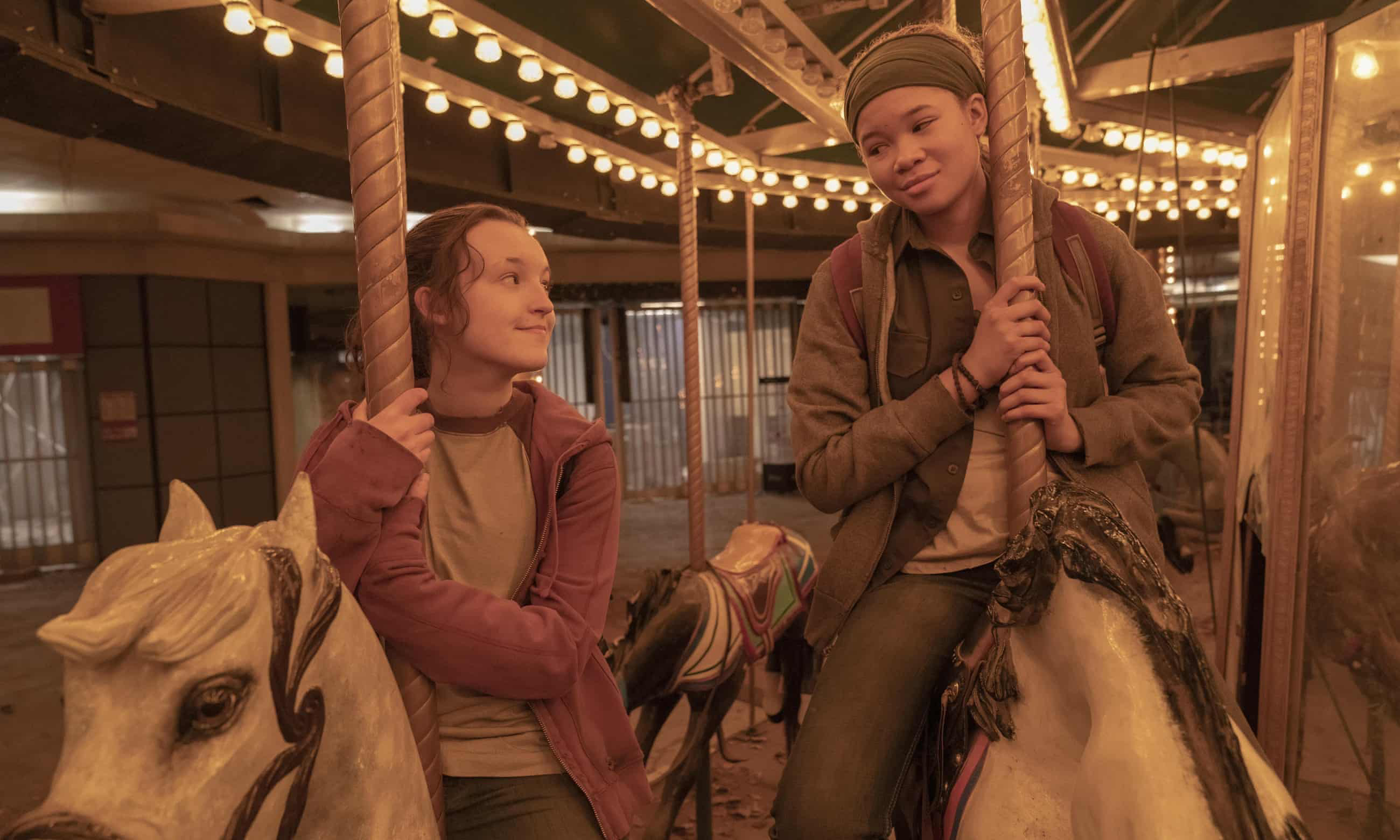
Fairground attraction … Ellie and Riley hang out on the carousel.
Photograph: Warner Media/HBO
The Last of Us recap episode seven
– the most painful farewell of all
G
Mon 27 Feb 2023 22.05 GMT
Last modified on Mon 27 Feb 2023 22.06 GMT
https://www.theguardian.com/tv-and-radio/2023/feb/27/
the-last-of-us-recap-episode-seven-the-most-painful-farewell-of-all
Les Anglonautes is optimized
for Firefox (desktop) and Firefox focus (mobile).

Navigating between an Anglonautes page
and an external page / link >
Going back to scroll position
A left click will take you back
to where you were
on the previous Anglonautes page.
When navigating back
from an external link to Anglonautes,
Chrome and Firefox use
a built-in browser engine feature
called BFcache (Back-Forward cache)
to try and restore your exact scroll position.
While this works seamlessly most of the time,
several technical factors explain
why it can fail,
instantly dropping you back
to the top of the page.
Disabling extensions helps fix the scroll issue
Many extensions—especially ad blockers,
cookie pop-up dismitters, and translation tools—
inject custom code into a web page.
Chrome and Firefox
detect these modifications and,
for security or structural reasons,
completely disable the BFcache.
Without this cache,
the browser cannot freeze the page,
forcing it to rebuild Anglonautes
from scratch and dropping you back at the top.
Other method
To guarantee you never lose
your reading position on Anglonautes,
avoid clicking external links directly.
Instead,
use tabbed navigation.
Right-click on the external link
and select "Open link in new tab",
or simply click the link
using your mouse's scroll wheel
(middle-click).
This opens the external content separately
while leaving your current Anglonautes tab open,
completely frozen at your current line of text.
bfcache explained
The back/forward cache, or bfcache,
is a performance-enhancing feature
available in modern browsers
that enables instant back and forward navigation
between previously-visited pages.
It does this
by storing a complete snapshot of a page
as the user navigates away from it;
the browser can then quickly restore the snapshot
if the user decides to return to it,
rather than needing to repeat the network requests
required to load the page.
The snapshot contains the entire page in memory,
including the JavaScript heap;
in-progress code is paused
when the user navigates away and resumed
when they return to the page.
A regular HTTP cache entry on the other hand
contains only responses to previous requests.
The bfcache therefore provides
faster results than the HTTP cache.
The downside is
that bfcache entries require more resources,
and create complexity
in terms of how to represent in-progress code.
Some code features
(for example the unload handler)
are not compatible,
so their presence on a page blocks it
from using the bfcache.
The bfcache is great for performance,
so it is in your interests to make sure
your pages are not blocked from using it.
You can use the notRestoredReasons API
to monitor whether pages are blocked
from using the bfcache, and reasons why.
https://developer.mozilla.org/en-US/
docs/Glossary/bfcache
Les Anglonautes
Learning English and discovering UK / US history
with news stories, illustrated stories, multimedia stories,
interactive stories, interactive maps, animated maps,
photographs, illustrations, cartoons, ads,
podcasts and videos
Today's focus > Arts > Series > USA >
Vocapedia > Beliefs, Emotions >
Worry, fear, dread, scare, anxiety
Vocapedia > Beliefs, Feelings >
terror, horror, stress, anxiety, phobia, shock
History > America, English America, USA, world
Microsoft FP report > 15 August 2026
55 327 embedded NPR podcasts
905 703 external hyperlinks
275 891 internal hyperlinks
8 676 style sheet links
all hyperlinks: 1 181 594
all files: 30 022
all images : 21 130
Pro-Sitemaps report > 15 August 2026
7 200 pages
15 130 images
6 394 videos
search Anglonautes

This site is best viewed full screen
on 2K photo editing monitors.
First responsive design edition by Camille
on Eizo CG 2730 :
December 2020.
First edition: September 2001.
warning:
potentially harmful content
This website contains graphic violence /
distressing content.
Some content (or its descriptions)
found on this site
may be harmful and difficult to view.
These materials may be graphic
or reflect biases.
We provide access to these materials
to preserve the historical record,
but we do not endorse the attitudes,
prejudices, or behaviors found within them.
Viewer discretion advised.
Anglonautes ®
is a nonprofit, educational website.
No cookies. No ads. No paid links / content.
No donations. No gifts. No perks.
No bank account.
Anglonautes ®
is dedicated to journalists
who have died or been jailed
in the line of duty.
https://www.theguardian.com/media/
journalist-safety
https://www.npr.org/2023/01/25/
1151272233/journalists-killed-2022-cpj-report
Anglonautes > Vocapedia > Journalist safety
17 U.S. Code § 107
Limitations on exclusive rights:
Fair use
Notwithstanding
the provisions of sections 106 and 106A,
the fair use of a copyrighted work,
including such use by reproduction
in copies or phonorecords
or by any other means specified by that section,
for purposes such as criticism,
comment, news reporting, teaching
(including multiple copies for classroom use),
scholarship, or research,
is not an infringement of copyright.
https://www.law.cornell.edu/uscode/text/17/107