


|
|
|
History > USA > Civil rights > Voting Rights Act
6 August 1965
A History of Voting Rights Video NYT 25 June 2013
For much of the 20th century, voting remained a contentious issue, but the Supreme Court struck down Section 4 of the 1965 Voting Rights Act on Tuesday, suggesting that conditions have changed.
Read the story here: http://nyti.ms/19qy1kg Watch more videos at: http://nytimes.com/video
YouTube https://www.youtube.com/watch?v=U4XtZ-tIzIA
President Johnson and the Voting Rights Act of 1965 27 February 2013
President Johnson and the Voting Rights Act of 1965 Video 27 February 2013
President Johnson goes beyond the previous year's triumph of the Civil Rights Act by pushing through legislative passage of the critical Voting Rights Act of 1965 that gave federal protection against voting discrimination to minority voters in several targeted states throughout the country.
John Fitz https://www.youtube.com/watch?v=-AN4NZSROvs
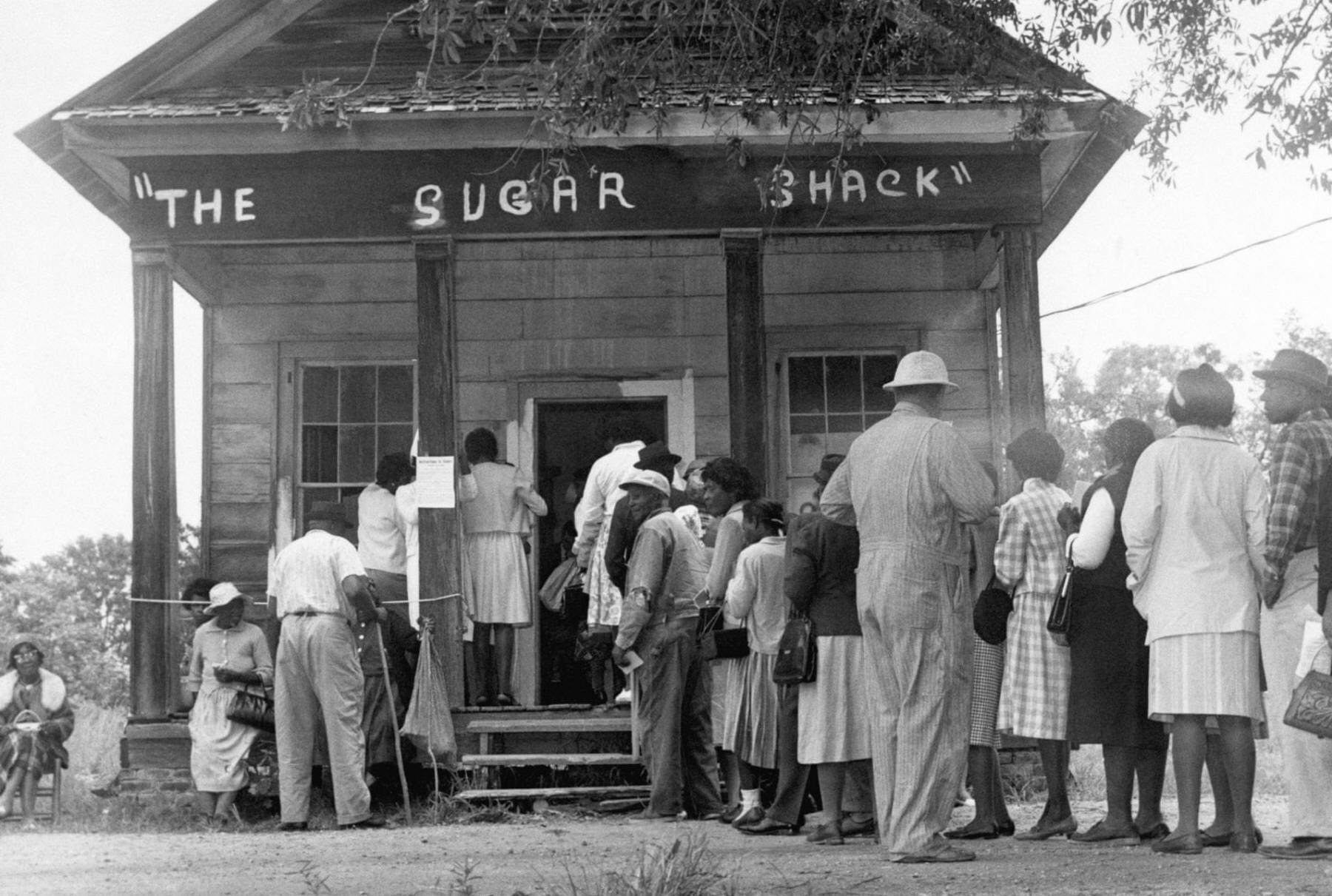
African American voters, able to vote for the first time in rural Wilcox county following the 1965 Voting Rights Act, Alabama, line up in front of a polling station at a local general store.
Photograph: Bettmann/Getty
Civil death: how millions of Americans lost their right to vote Voter disenfranchisement is an American tradition – we look at the historical roots of civil death G Fri 7 Aug 2020 13.00 BST Last modified on Fri 7 Aug 2020 18.36 BST
https://www.theguardian.com/us-news/2020/aug/07/
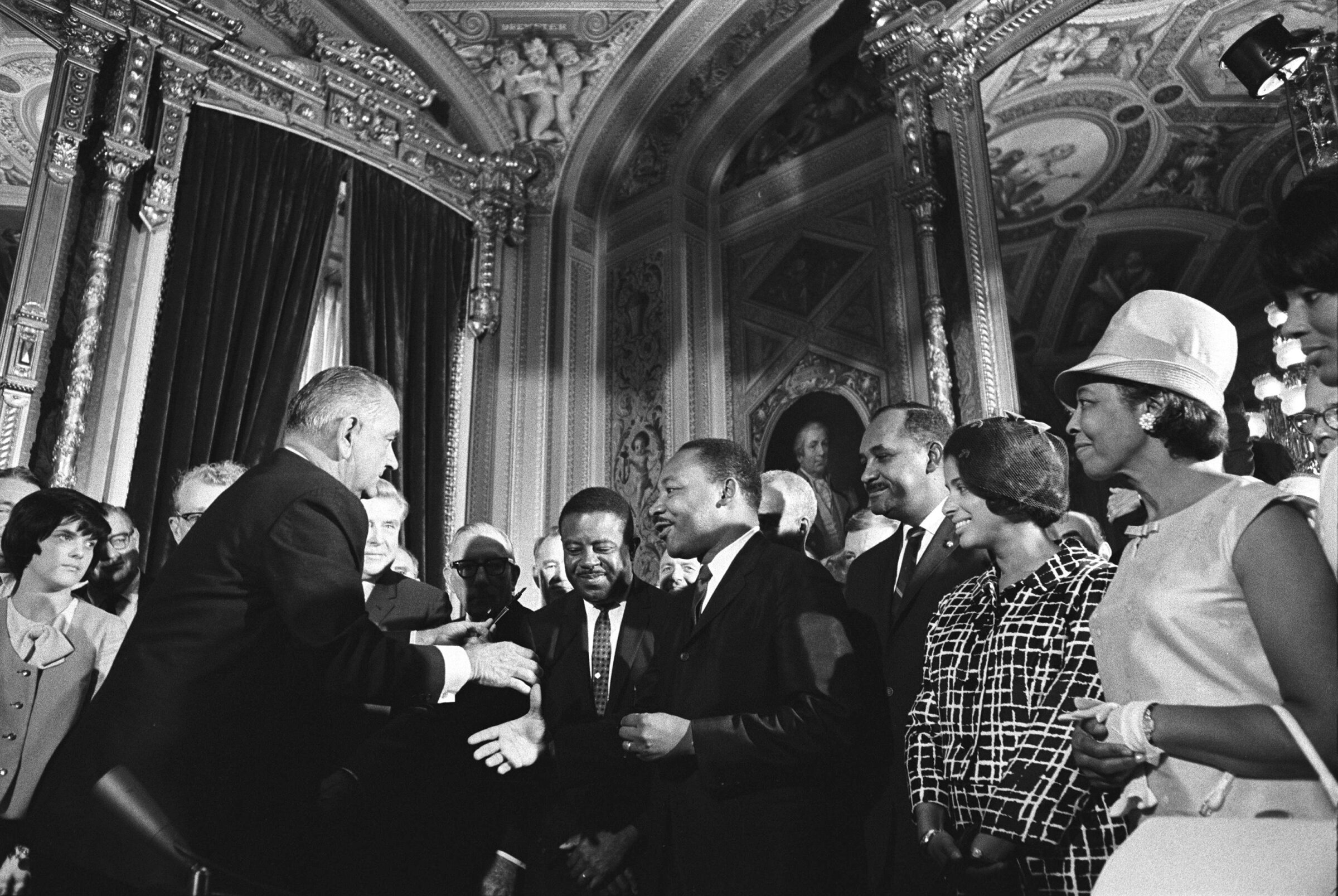
President Lyndon B. Johnson moves to shake hands with Martin Luther King Jr. while others look on after Johnson signed the federal Voting Rights Act into law at the U.S. Capitol in Washington, D.C., on Aug. 6, 1965.
Photograph: Yoichi Okamoto/Lyndon B. Johnson Library
60 years later, Voting Rights Act protections for minority voters face new threats NPR August 6, 2025 5:00 AM ET
https://www.npr.org/2025/08/06/
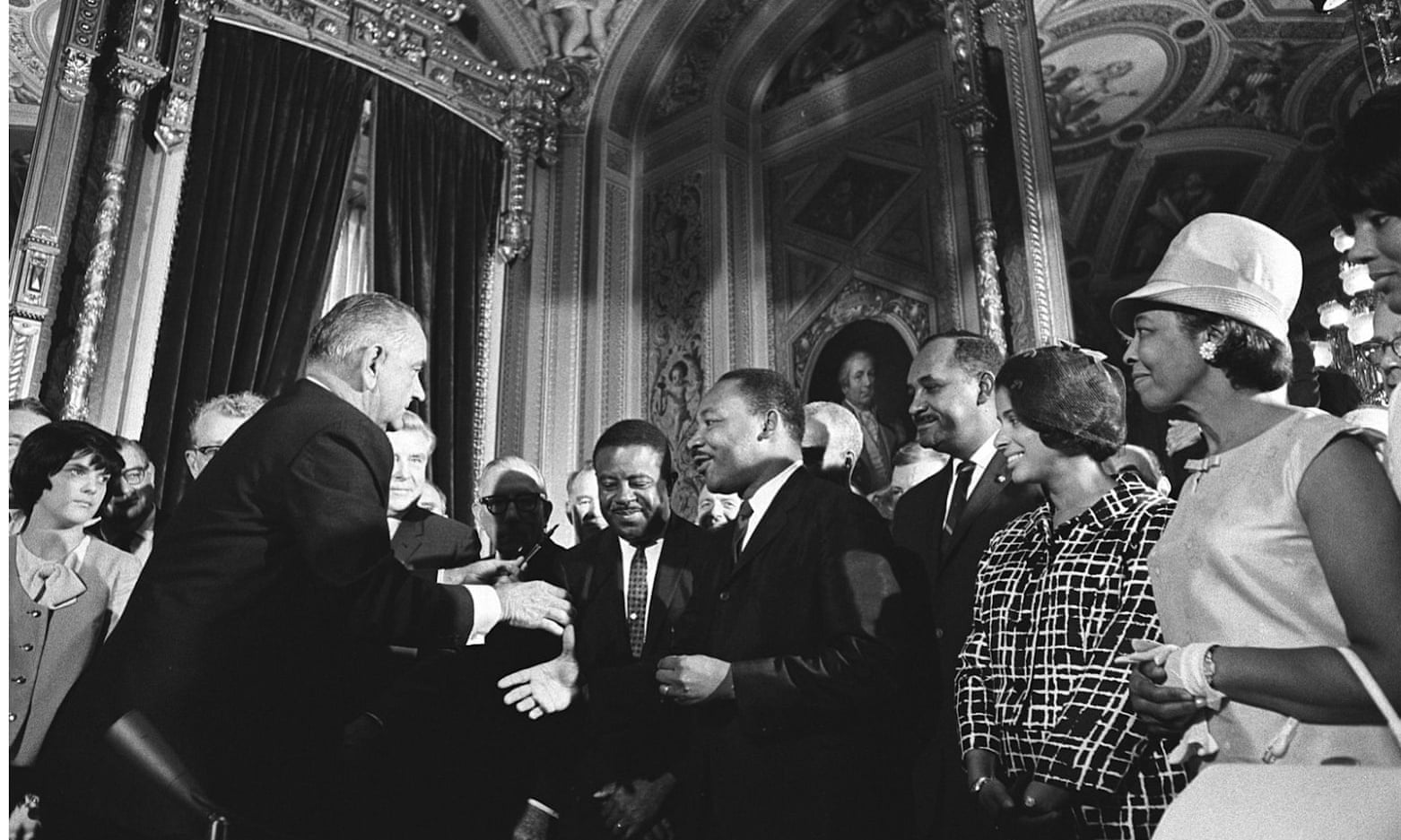
Lyndon Johnson meets Martin Luther King at the signing of the Voting Rights Act of 1965.
Photograph: Lyndon Johnson Library and Museum
Civil death: how millions of Americans lost their right to vote Voter disenfranchisement is an American tradition – we look at the historical roots of civil death G Fri 7 Aug 2020 13.00 BST Last modified on Fri 7 Aug 2020 18.36 BST
https://www.theguardian.com/us-news/2020/aug/07/
August 6, 1965
Voting Rights Act
On 6 August 1965 President Lyndon B. Johnson signed the Voting Rights Act into law, calling the day ‘‘a triumph for freedom as huge as any victory that has ever been won on any battlefield’’ (Johnson, ‘‘Remarks in the Capitol Rotunda’’).
The law came seven months after Martin Luther King launched a Southern Christian Leadership Conference (SCLC) campaign based in Selma, Alabama, with the aim of pressuring Congress to pass such legislation.
‘‘In Selma,’’ King wrote, ‘‘we see a classic pattern of disenfranchisement typical of the Southern Black Belt areas where Negroes are in the majority’’ (King, ‘‘Selma— The Shame and the Promise’’).
In addition to facing arbitrary literacy tests and poll taxes, African Americans in Selma and other southern towns were intimidated, harassed, and assaulted when they sought to register to vote.
Civil rights activists met with fierce resistance to their campaign, which attracted national attention on 7 March 1965, when civil rights workers were brutally attacked by white law enforcement officers on a march from Selma to Montgomery.
Johnson introduced the Voting Rights Act that same month, ‘‘with the outrage of Selma still fresh’’ (Johnson, ‘‘Remarks in the Capitol Rotunda’’).
In just over four months, Congress passed the bill.
The Voting Rights Act of 1965 abolished literacy tests and poll taxes designed to disenfranchise African American voters, and gave the federal government the authority to take over voter registration in counties with a pattern of persistent discrimination.
‘‘This law covers many pages,’’ Johnson said before signing the bill, ‘‘but the heart of the act is plain.
Wherever, by clear and objective standards, States and counties are using regulations, or laws, or tests to deny the right to vote, then they will be struck down’’ (Johnson, ‘‘Remarks in the Capitol Rotunda’’).
http://mlk-kpp01.stanford.edu/index.php/encyclopedia/encyclopedia/
By 1965 concerted efforts to break the grip of state disfranchisement had been under way for some time, but had achieved only modest success overall and in some areas had proved almost entirely ineffectual.
The murder of voting-rights activists in Philadelphia, Mississippi, gained national attention, along with numerous other acts of violence and terrorism.
Finally, the unprovoked attack on March 7, 1965, by state troopers on peaceful marchers crossing the Edmund Pettus Bridge in Selma, Alabama, en route to the state capitol in Montgomery, persuaded the President and Congress to overcome Southern legislators' resistance to effective voting rights legislation.
President Johnson issued a call for a strong voting rights law and hearings began soon thereafter on the bill that would become the Voting Rights Act.
Congress determined that the existing federal anti-discrimination laws were not sufficient to overcome the resistance by state officials to enforcement [ In 1870 the 15th Amendment was ratified, which provided specifically that the right to vote shall not be denied or abridged on the basis of race, color or previous condition of servitude.
This superseded state laws that had directly prohibited black voting.
Congress then enacted the Enforcement Act of 1870, which contained criminal penalties for interference with the right to vote, and the Force Act of 1871, which provided for federal election oversight ].
The legislative hearings showed that the Department of Justice's efforts to eliminate discriminatory election practices by litigation on a case-by-case basis had been unsuccessful in opening up the registration process;
as soon as one discriminatory practice or procedure was proven to be unconstitutional and enjoined, a new one would be substituted in its place and litigation would have to commence anew. http://www.justice.gov/crt/about/vot/intro/intro_b.php
the formula Congress devised in 1965 (...) required all or parts of 16 states with long histories of overt racial discrimination in voting, most in the South, to get approval from the federal government for any proposed change to their voting laws.
This process, known as preclearance, stopped hundreds of discriminatory new laws from taking effect, and deterred lawmakers from introducing countless more. http://www.nytimes.com/2015/04/19/opinion/sunday/voting-rights-by-the-numbers.html
Signed on Aug. 6, 1965, it was meant to correct “a clear and simple wrong,” as Lyndon Johnson said.
“Millions of Americans are denied the right to vote because of their color.
This law will ensure them the right to vote.”
It eliminated literacy tests and other Jim Crow tactics, and — in a key provision called Section 5 — required North Carolina and six other states with histories of black disenfranchisement to submit any future change in statewide voting law, no matter how small, for approval by federal authorities in Washington.
No longer would the states be able to invent clever new ways to suppress the vote.
Johnson called the legislation “one of the most monumental laws in the entire history of American freedom,” and not without justification.
By 1968, just three years after the Voting Rights Act became law, black registration had increased substantially across the South, to 62 percent.
http://www.nytimes.com/2015/07/29/
https://www.archives.gov/milestone-documents/
https://www.history.com/topics/black-history/
https://www.justice.gov/crt/ https://avalon.law.yale.edu/subject_menus/statutes.asp https://avalon.law.yale.edu/20th_century/voting_rights_1965.asp
https://www.nytimes.com/topic/subject/ https://kinginstitute.stanford.edu/voting-rights-act-1965
https://en.wikipedia.org/wiki/
https://edition.cnn.com/2008/LIVING/studentnews/02/04/
https://www.npr.org/2025/08/06/
https://www.theguardian.com/us-news/2020/aug/07/
https://www.nytimes.com/2020/07/17/
http://www.nytimes.com/2016/04/28/
http://www.nytimes.com/2016/03/31/
http://www.nytimes.com/2015/08/27/us/
http://www.nytimes.com/2015/08/30/
http://www.nytimes.com/2015/08/16/
http://www.nytimes.com/2015/08/07/
http://www.nytimes.com/2015/08/06/
http://www.nytimes.com/2015/08/04/
http://www.nytimes.com/2015/07/29/
http://www.nytimes.com/2015/04/19/
http://www.nytimes.com/2015/03/15/
http://www.nytimes.com/2013/06/26/us/
http://www.nytimes.com/interactive/2013/06/26/us/
http://www.nytimes.com/interactive/2013/06/25/us/
https://www.supremecourt.gov/opinions/12pdf/12-96_6k47.pdf
http://www.nytimes.com/2009/04/29/
http://georgewbush-whitehouse.archives.gov/
http://www.nytimes.com/1982/06/30/
https://www.nytimes.com/1965/08/08/
https://www.nytimes.com/1965/08/07/
https://www.nytimes.com/1965/08/07/
https://www.nytimes.com/1965/08/07/
https://www.nytimes.com/1965/03/16/
https://archive.nytimes.com/www.nytimes.com/books/98/04/12/
https://www.nytimes.com/1965/03/14/
A Brief History of the Black Vote (Up to the Voting Rights Act)
http://www.nytimes.com/2015/07/29/
A More Perfect Union Story Corps 30 June 2015
A More Perfect Union Video Story Corps 30 June 2015
When Theresa Burroughs came of voting age, she was ready to cast her ballot —but she had a long fight ahead of her.
During the Jim Crow era, the board of registrars at Alabama's Hale County Courthouse prevented African Americans from registering to vote.
Undeterred, Theresa remembers venturing to the courthouse on the first and third Monday of each month, in pursuit of her right to vote.
Directed by: The Rauch Brothers Art Direction: Bill Wray Producers: Lizzie Jacobs, Maya Millett & Mike Rauch Animation: Tim Rauch Audio Produced by: Nadia Reiman & Katie Simon Music: Fredrik Label: The Kora Records Publisher: House of Hassle
Funding Provided by: Corporation for Public Broadcasting
W.K. Kellogg Foundation
YouTube https://www.youtube.com/watch?v=AA87JWa0bEw
Related https://www.youtube.com/watch?v=YVirtwZzJ2Q
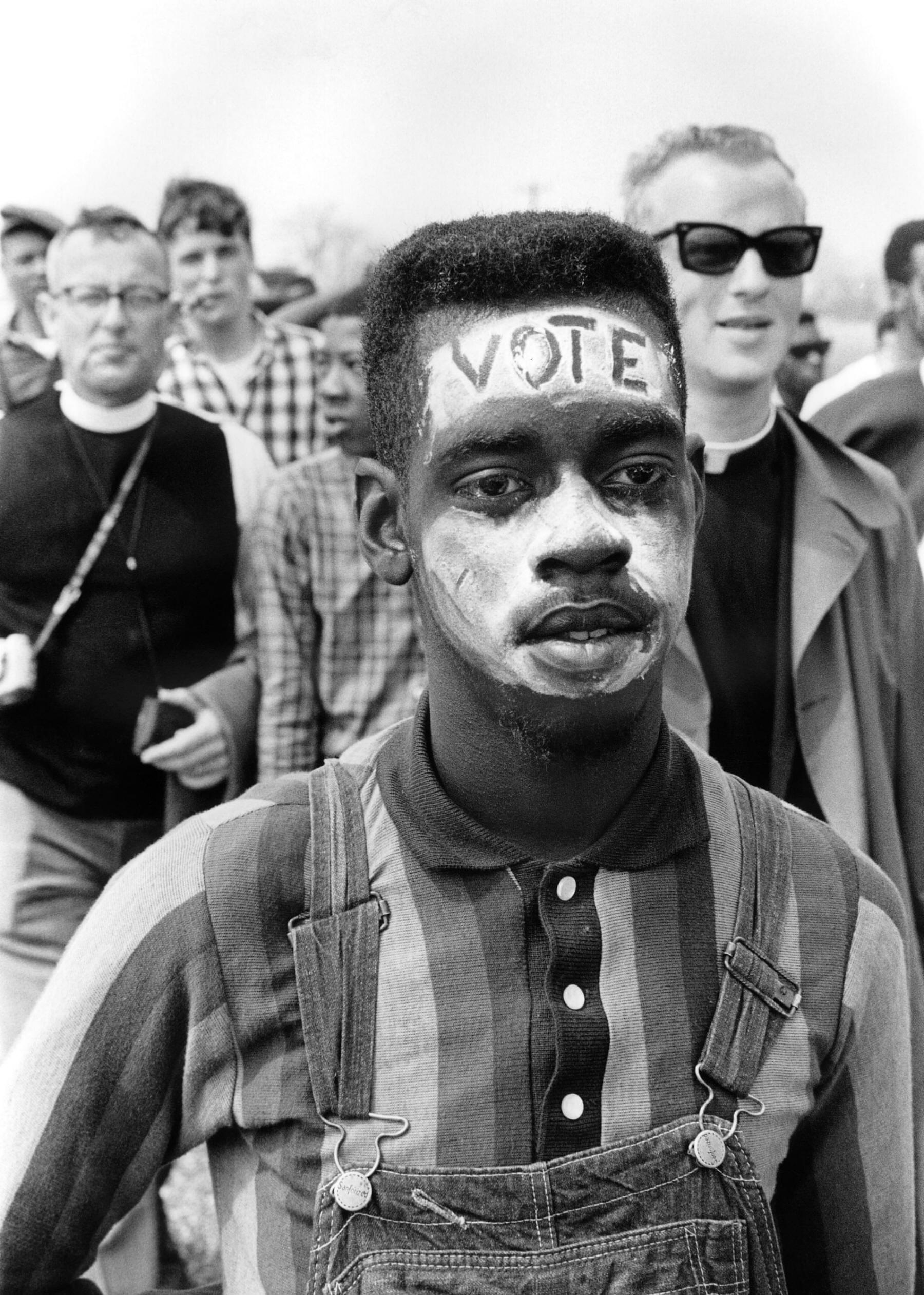
A protester at the March on Washington for Jobs and Freedom
Photographer: Matt Herron
Matt Herron, chronicler of the US civil rights movement – in pictures The photographer, who covered protesters and volunteers across the south, has died at 89. His shot of a policeman assaulting a child won him a World Press Photo award. Images courtesy of Take Stock/Topfoto G Fri 21 Aug 2020 11.42 BST
https://www.theguardian.com/artanddesign/gallery/2020/aug/21/
Related > Anglonautes > History
Voting rights marches from Selma to Montgomery
First march / "Bloody Sunday" march
Lyndon Baines Johnson 1908-1973 36th President of the United States 1963-1969
20th century > USA > Civil rights
17th, 18th, 19th, 20th century
Related > Anglonautes > Vocapedia
Anglonautes > Arts > Photographers > 20th century > USA > Civil rights
James "Spider" Martin 1939-2003
|
|
|